

SAN ANGELO, TX — A group led by anti-data center activist Richard Summers failed to gather enough signatures to force a recall of San Angelo Mayor Tom Thompson.
Summers, through the San Angelo Data Center Citizen Coalition, filed the recall petition last month. The effort targeted Thompson over allegations of insufficient transparency during negotiations to sell city-owned land to Emergent/Skybox Datacenters for the proposed 1.2-gigawatt Skybox Data Center Complex. Thompson has denied any wrongdoing. Some observers said the recall threat appeared to encourage city leaders to share more details about the project with the public.
Under city rules, the coalition needed 2,971 valid signatures — 30% of the votes cast in the May 2025 mayoral election — by the June 22, 2026 deadline. City Clerk Heather Stastny said Summers submitted fewer than 1,900 signatures and requested verification. He delivered roughly 600 pages of petitions, representing about two-thirds of the required total. Upon leaving the clerk’s office at 4:45 p.m., Summers stated only, “I turned in the paperwork,” and declined further comment.
The coalition has launched recall efforts against multiple city council members, though not against Councilwoman Karen Hesse-Smith. Sources inside the anti-data center coalition tell us that Hesse-Smith is working hand-in-hand with the data center opposition. Last meeting, Councilwoman Mary Coffey stated her opposition to data centers, but this apparently did not persuade Summers to not seek her recall.
Councilman Harry Thomas in Single Member District 3 faces the lowest signature threshold: just 47 signatures from registered voters living in his district, based on the 155 votes cast in his last election. His petition deadline is July 28, 2026.
Thomas has served on the council for approximately 10 years. The recall news has been stressful for him. If the effort succeeds, it could trigger multiple special elections — potentially two related to the recall itself and one to fill the seat when Thomas' term ends in May 2027. Each election is estimated to cost taxpayers $30,000 to $50,000 through a contract with the Tom Green County Elections Office.
In earlier comments, Thompson noted that if the council were allowed to appoint a replacement for Thomas, members might choose to reappoint Thomas himself to finish his term. An ouster before the term ends could also reset term limits, potentially allowing Thomas to run in a special election and serve another eight years if successful.
Thus far, no one from the anti-data center side has publicly suggested or endorsed any specific replacement candidates for the offices they are seeking to vacate through recall.
The coalition has described the mayor’s recall as a referendum on whether San Angelo supports data center development. The failure to reach the signature threshold may suggest that many residents either see economic benefits in the project or remain undecided, even as Summers spurs his group to be very vocal.
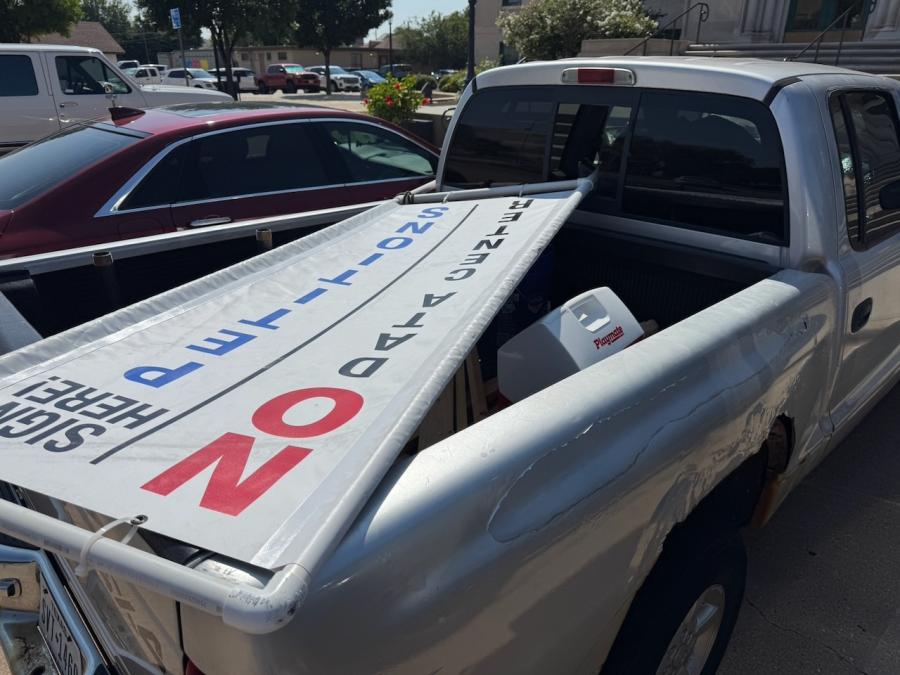
A sign advertising the recall petition of Mayor Tom Thompson in the back of Richard Summers' rusty, old Dodge pickup. He drove to city hall to deliver only 2/3s the petitions required to recall Mayor Tom Thompson.
What’s at Stake
The proposed Skybox Data Center Complex by Emergent/Skybox Datacenters would be one of the largest infrastructure projects considered in San Angelo in recent years. Supporters point to potential construction and operational jobs, increased tax revenue for city services, and long-term economic positioning as the region competes for data and technology investment.
Opponents, led by the San Angelo Data Center Citizen Coalition, have focused on the project’s resource demands and questions about how the land sale and related agreements were handled. Public meetings earlier this year showed a mix of support and skepticism, with residents asking about electricity needs, water for cooling, noise, and the overall decision-making process. City officials and project representatives have stated that power allocation from ERCOT is still pending and have sought to clarify details on water use and site plans. News of who gets the power allocation from ERCOT is expected to land in mid-July.
Two data centers in the San Angelo area have paid the $16 million kayak fee to be considered: Emergent and Cipher data centers are both proposed to be located side-by-side off City Farm Road but Cipher is located outside the city limits but inside Tom Green County. The Cipher datacenter requested 1 GW of power; Emergent requested 1.2 GW of power. The Red Creek Power Station was reported to carry 765 MW of power. If ERCOT and AEP are unable to upgrade the infrastructure quickly, ERCOT may approve only one or the other data center project. If the Cipher datacenter is approved over the Skybox data center, the CIty of San Angelo will not realize the property valuation gains and resulting increase in sales tax and property tax revenue but will still experience the population growth, increased rents, and stress on the city police force.
Data center proposals across the United States have raised recurring community questions, including:
- Energy consumption: Facilities can require hundreds of megawatts to gigawatts of power, contributing to grid pressure and, in some cases, higher utility costs for local customers.
- Water use: Cooling systems in traditional designs can consume millions of gallons per day. While newer technologies (air cooling, immersion, or reclaimed water) reduce demand, concerns remain in regions that track drought conditions.
- Noise and air quality: Continuous operation of fans, HVAC systems, and diesel backup generators can create audible hums and occasional emissions that affect nearby residents.
- Land use and economics: Projects often involve rezoning and tax incentives. Critics frequently ask whether permanent job numbers and local benefits outweigh the infrastructure costs and incentives provided.
- Transparency: Some agreements include confidentiality provisions, which can limit public visibility into full project details and long-term commitments.
A May 2026 thread on X by energy communications specialist Steve Everley compared many of these arguments to those used in earlier fights over hydraulic fracturing. It highlighted overlapping claims on health impacts, property values, water, job creation, corporate secrecy through NDAs, and calls for moratoriums — themes sometimes advanced by the same advocacy networks. The thread noted that while communities have valid reasons to scrutinize large projects, some claims followed patterns seen in prior debates where initial assertions were later proven overstated.
Nationally, additional debate has emerged about whether opposition to data centers and related AI infrastructure is being amplified by organized funding, particularly from the Chinese Communist Party. Reports and congressional inquiries have pointed to networks involving foreign-tied dark money and, in some allegations, influence linked to China that could aim to slow U.S. technological development.
In the San Angelo recall effort, available public information shows the campaign driven by local residents focused on transparency and resource issues. Yet, the San Angelo Data Center Citizen Coalition maintains a professional website, a polished social media presence (especially on Facebook), and well-produced video content. Questions have been raised about how Richard Summers — described as a voice actor and priest from a defunct congregation — has the expertise or resources to sustain this level of professional operation without external funding, and who, if anyone, might be supporting it.
Summers has stated that his group is not formally organized as a 501(c)(3) nonprofit. Despite the political campaign nature of the effort, no city or state statutes require him to register as a political action committee (PAC). No filings are required with the city or the State Ethics Commission that would reveal who is funding the campaign. As a result, no documented direct ties to external funding sources have appeared in current public reporting.
The outcome of the mayor’s recall petition leaves the data center project moving through remaining regulatory and permitting steps, while the coalition continues separate recall efforts against certain council members.


Subscribe to the LIVE! Daily
Required
Comments
Listed By: Wiley Coyote
Surely someone didnt pour algae chemical in the pool????
- Log in or register to post comments
PermalinkPost a comment to this article here: