

SAN ANGELO, TX — Data center developer Cipher Digital told the Tom Green County Commissioners Court Tuesday it picked the county for one reason: the Red Creek substation. The AEP Texas Red Creek 345-kV Station off City Farm Road is the crown jewel attracting two large-load data center projects to the San Angelo area. Two companies, Emergent and Cipher Digital, on adjacent plots of land, are vying for an interconnect with the station for juice to power a 1.2 GW and a 1 GW facility, respectively.
From an earlier brochure by Emergent, the company said Red Creek already consists of dual 345-kV circuits, plus 138-kV. There are claims this can be expanded. After Tuesday’s meeting, County Judge Lane Carter said he was told only five stations in the country have that kind of capacity. That may or may not be true, but whatever potential Red Creek has for large-load interconnectivity, it has attracted 2.2 GW of data center power applications.
Cipher's Lee Bratcher told the court the station has potential for more than 3,000 MVA of capacity — more than double the 1 gigawatt Cipher is asking ERCOT for, and enough, on paper, to fully power both data centers proposed near the substation.
Learning how valuable Red Creek was broke news yesterday. The rest of the morning was the usual quibbling about water use, lights, taxes, and wear and tear on City Farm Road, in a room that was vocally against any type of data center development inside the county.
Cipher Digital’s Bratcher, Jordan Tinsley and Andrew Rios presented their plans to the court. There was no vote. Carter said Cipher first asked to meet him and the commissioners in private. He said no. He did not want a conspiracy story. So they did it in open court.
Bratcher denied any NDA with the court or any Tom Green County official. He said they will talk in public.
Cipher purchased a few hundred acres off Highway 67 North, south down City Farm Road to Red Creek, with options that would take it to about 600 acres. Red Creek sits in the middle of the Cipher land. Cipher said it has paid AEP a $17 million interconnection fee to connect with ERCOT’s grid. They said they have conditional utility authority, but with data center opposition becoming the centerpiece of the November election, and Gov. Greg Abbott’s decision to audit all large-load projects before ERCOT can approve them, Cipher and any other data center developer in the state does not have certainty of a grid connection.
Cipher and Emergent are both in Batch Zero of large-load requests. The decision is on hold until Gov. Greg Abbott’s large-load audit is complete. Bratcher said they will not know if they can build here until Dec. 7, the latest estimate for when ERCOT makes its next announcement.
Data centers are large apartment buildings for powerful computers that drive AI, cryptocurrency mining, and data storage and app/website functionality. For companies like Cipher, they need lease agreements with co-location customers. So far, Cipher told the court, no tenant has signed a lease for its Tom Green County facility. Other Cipher data centers host Amazon Web Services, Google, Anthropic, and Fluidstack.
Commissioner Rick Bacon asked how large the footprint will be. Bratcher said that waits on a tenant. Bacon asked how Cipher can finance a building nobody has rented. Bratcher said the company is well capitalized — about $8 billion in market capitalization and $1 billion in cash and equivalents. He said Cipher issues bonds, and does not flip sites. “We own and operate our own facilities,” Bratcher said, pointing to the company’s reputation as a data center development and operations corporation.
If Cipher can clear the audit, Bratcher said they will finalize the design in the fourth quarter and major construction begins in the first quarter of 2027. The Cipher data center will take 14 to 20 months to complete. The first construction work will originate at the substation. From the county, Cipher will need a road-use agreement for City Farm Road.
Bratcher told the court the center will use a closed-loop cooling system with air-cooled chillers. Their plan is to truck in 2 million gallons of non-potable water to fill the cooling system, using produced or brackish water. After that, ongoing water consumption will be about 5 gallons a day per employee. Bratcher compared that to less than a 100-room hotel.
Commissioner Chad Decker (Pct. 2) said water is precious and he wants safeguards against groundwater pollution. Bratcher said the loop chemicals are not dangerous but will be treated by the company as if the water was. And, he said, a spill would be treated as serious.
Bratcher emphasized again and again that the Cipher data center project will not use potable water for cooling, construction, dust mitigation, or even in the concrete mix. He promised, too, that the water will not be discharged downstream. Water used in the closed-loop system will be treated, barreled, and hauled off when it is changed out.
They are not drilling 200-foot drinking wells, he said. They bought the land because Red Creek sits in the middle of the property not because of the ground water potential.
Commissioner Ralph Hoelscher: “Are you expecting a tax break? I want you to pay your taxes just like I pay mine and everyone else pays theirs.”
Bratcher said they are not chasing an abatement. He left one opening: a deal that ties operating rules to a tax agreement so the court has something to enforce.
Hoelscher did not bite. The Legislature is already limiting the money counties can raise through property taxes, he said. That is why he is against tax breaks. “I will be the first one to vote against it.”
Carter said any abatement request would be treated like the county has previously negotiated for solar and wind projects.
The Cipher data center will provide at least 100 permanent jobs, maybe 200 to 300. Bratcher’s best guess was about 200. The pay will range from a $25-an-hour security guard to six figures. Bratcher said the average salary will be $70,000 to $80,000 a year.
Commissioner Shawn Nanny (Pct. 4) asked about 1,000 construction workers during the building phase. Bratcher said Mitchell County, where Cipher is building a smaller data center several miles north of Colorado City, hired about 10 percent local construction workers. But Colorado City, population about 4,000, has a very small workforce. San Angelo will do better. Nanny said he wants 50 percent or more local workers hired for construction.
The discussion turned to housing, probably the biggest sticking point for data center opponents. Bratcher said area hotels will likely house a majority of the workers.
“We’ll use the free market,” he said.
Colorado City hotels are already full. Nanny flagged ASU students not being able to afford to live in San Angelo because of high rent. Judge Carter flagged rodeo and stock show months of high hotel capacity. Construction lasts almost two years.
Nanny asked if Bratcher would live next to a data center. Bratcher said he lives in Richardson with about 40 data centers. He said they’re quiet, and traffic was already bad before data centers were built there.
Left-wing anti-data center activist Allie Devereaux, who owns land near the site, was not buying the Richardson comparison. She said all the data centers in Richardson together draw 88 megawatts. Cipher is talking 1,000.
Bratcher said no Cipher-built solar or wind facilities are planned. There will be a four-hour battery backup. Cipher has no TCEQ power-plant application.
Carter asked whether Red Creek can feed Cipher and Emergent. Bratcher said the potential is there. He also said he does not see both companies getting their full 1.2 GW and 1 GW ERCOT and AEP allocations at the start.
Nanny demanded a full-time, on-site ombudsman. He also wants a decommissioning bond if the boom dies and the data center building is left vacant. He added that he wants an operational agreement (a Chapter 381 agreement for counties) with stringent penalties that shut the place down if Cipher violates the agreement.
Reading the Room
Former volunteer fireman from Wall James Hopper came up in a leg brace and a ball cap. He was generally hostile toward the tech guys from Cipher. “Who regulates the tenant? If they haul the water in, haul the water. Do what you said. Who signs the paper?” he demanded.
Nanny told him it is private land and the state did not give counties many tools to get around private property rights. Hopper asked how many more of these data centers the county needs, then dismissed Cipher’s donations to volunteer fire departments reported in the news earlier. “Those departments don’t need more trucks,” he said. “They need more people.”
Kimberly Greenfield, realtor and appraiser, told Cipher’s executives that people live on City Farm Road on purpose. “You’re going to screw up City Farm Road.” She then called data centers evil and said Cipher should buy the neighbors out because property values may drop.
Wrey Montgomery, a banker, stood up for Cipher. He claimed he had no dog in the hunt, but he can speak to Colorado City, where his bank is based. His bank handles the nonprofit foundation Cipher helped fund there with $10 million.
Kelly Garrett, rancher’s wife and lifelong county resident, reminded the court that what happens in agriculture starts here, in rural areas where data centers appear to be proliferating.
Devereaux alleged a Cipher executive named “William” had an NDA with a local elected official. Cipher said they knew nothing about an NDA with a San Angelo government official. There may have been one with San Angelo Chamber economic development. Bratcher said those were rescinded. “We want to be out in the open about all of this,” he promised.
Devereaux, perhaps jealous Cipher didn’t buy her land, said she heard Cipher paid $100,000 an acre. Bratcher denied it and would not give a number. Talk around town is about $30 million total, or roughly $50,000 an acre. That number is unverified.
City Councilman Patrick Keely told the court to get everything in writing. He confirmed the site sits in Veribest ISD. Robin Hood laws cap what property tax money Veribest ISD can keep. Most of the new tax money will end up in Austin, he said. He suggested spreading property tax revenue across all area school districts. He also asked for a floor on neighboring property values — a deal so people in a set radius can sell at or above a number once the plant is running. He also suggested that construction be scheduled to ease up during stock show and rodeo to open up hotel room availability.
Hoelscher presented the money quote for the hearing, on water: “Whiskey was made to drink, water was made to fight over.”
Carter concluded the meeting with a plea for some latitude for elected officials to work with the data center boom. He said the fear of “damned near getting crucified” makes it hard to represent people well.
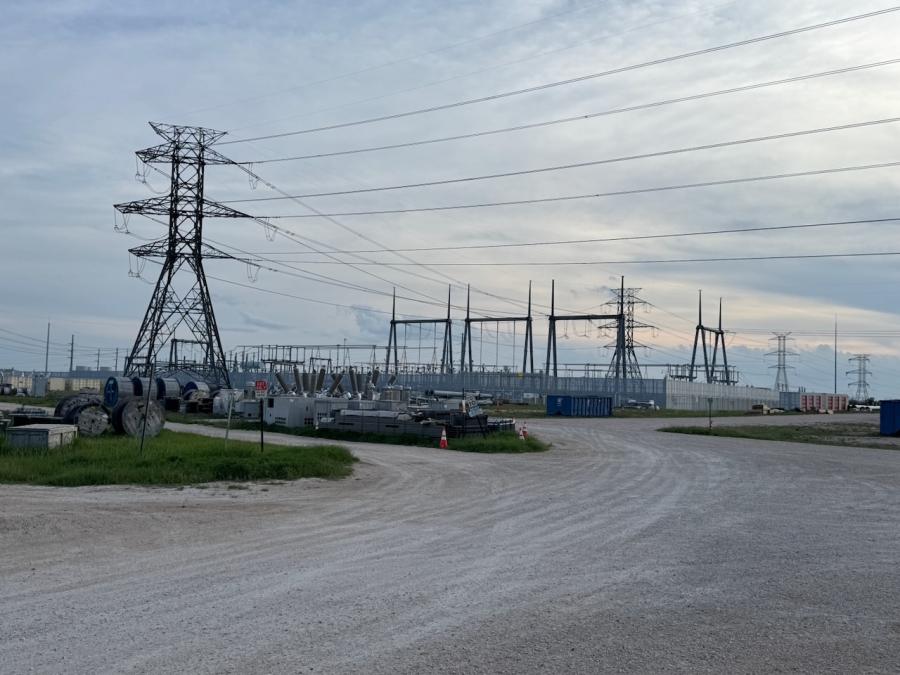
The Red Creek power substation is at the center of the data center infrastructure plan for two adjacent plays. It's located off City Farm Road just south of US 67 north.
Subscribe to the LIVE! Daily

Required
Comments
Listed By: Rita Repulsa
For years I've been telling people from Abu Dhabi to Timbuktu, Ireland proper to southern Mexico, about how special and important this particular substation truly is.
- Log in or register to post comments
PermalinkPost a comment to this article here: