

SAN ANGELO, TX — Double J Lamb was a gold-chip company the San Angelo economic development complex worked to recruit. It had all the makings of a deal from heaven. Once again, the sheep and mohair capital of the world had a functioning lamb industry. But all of those successes apparently have failed as the primary lender for Double J Lamb is calling for its liquidation. Here are the details.
In 2020, the City of San Angelo facilitated the return of commercial lamb processing to the Concho Valley by authorizing a lease of the long-idle, city-owned plant on City Farm Road to the Hasbrouck family of Ault, Colorado, and their companies Double J Meat Packing and Double J Lamb Feeders. City Council approved the city manager to negotiate the lease in early September 2020. The facility was renamed Double J Lamb Inc. – Texas and was positioned as a major win for local economic development and the broader sheep industry.
The plant itself carries a longer history. Originally opened as Ranchers’ Lamb of Texas in 1998, with a fabrication wing added in 2001, the facility was designed to process roughly 1,700 to 1,800 head of lambs per day. It closed in February 2005 due to a shortage of animals and sat largely unused for 15 years before the Hasbroucks took it over. At the time of the 2020 deal, city officials noted that past amounts owed by the previous operator would be reimbursed as part of the arrangement, and the plant was described as being in good condition and ready to be returned to full operation.
The Hasbrouck family’s business model was built around vertical integration and protecting their existing customers. They already operated a large custom lamb feedlot in Colorado (Double J Lamb Feeders) that typically fed 150,000 to 175,000 lambs per year, most of them belonging to members of the Mountain States Lamb Cooperative. When the cooperative’s main processor, Mountain States Rosen, went bankrupt in 2020 and closed its Greeley, Colorado plant, the family faced a serious bottleneck. They acquired the San Angelo facility specifically to provide both harvest (slaughter) and full fabrication capacity for those customers, as well as lambs from the western range and Texas producers. Jeff Hasbrouck said at the time that the family felt they “owed it” to the producers whose lambs they were feeding to ensure those animals still had a reliable place to be processed. The plant was expected to handle about 1,800 head per day and process roughly 200,000 lambs annually once fully ramped up, while also supporting local Texas sheep and goat growers.
That chapter now appears to be ending.
On August 3, 2026, American AgCredit, FLCA filed a verified original complaint in the U.S. District Court for the Northern District of Texas, San Angelo Division, seeking to collect more than $7.5 million in unpaid loans and to foreclose on the City Farm Road property and related collateral. The lawsuit names Double J Lamb Inc. as the primary borrower along with multiple affiliated companies and individual guarantors from the Hasbrouck family, including Jeffrey Roy Hasbrouck, Jay Charles Hasbrouck, Jo Ellen Hasbrouck, and Kelli Crider.
According to the complaint, the company’s financial problems were longstanding.
“From its inception, Double J’s lamb processing operation was plagued by undercapitalization, operational losses, and inadequate financial reporting,” the lawsuit states. “Beginning in August 2022, Double J’s borrowing base submissions reflected persistent deficits. And these recorded shortfalls presented real-world consequences: Double J was unable to generate sufficient revenue to cover its increasing debt service costs.”
The lender issued multiple default notices over the years, including in January 2023, September 2023, and September 2025. By October 2025, the company faced a complete lack of liquidity. Double J ceased operations entirely that month amid more than $1 million in unpaid accounts payable and alleged violations of the Packers and Stockyards Act. Loan payments stopped shortly afterward. American AgCredit claims multiple events of default under a 2021 Master Loan and Membership Agreement and related notes that originally totaled more than $8.2 million. As of March 26, 2026, the outstanding balance stood at approximately $7.59 million in principal and accrued interest. The lender is asking the court for judgment on the debt, foreclosure of the real and personal property collateral, and the appointment of a receiver to protect the asset from further waste or deterioration.
The broader U.S. lamb market during this period does not appear to explain the failure on its own. While the domestic sheep flock has continued a long-term decline and imports from Australia and New Zealand now supply roughly 70 percent of U.S. consumption, prices and demand have generally remained supportive. Slaughter lamb and feeder lamb prices spiked in 2021, remained historically solid through much of 2022–2024, and strengthened significantly again in 2025 and early 2026. Retail demand for lamb has held up as a premium protein, and industry reports from the American Lamb Board and others describe the recent market as resilient rather than depressed. The lawsuit’s own description of persistent borrowing-base deficits, undercapitalization, and operational losses dating back years points more toward company-specific financial and operational challenges than an industry-wide collapse.
A visit to the City Farm Road location this week found no vehicles, no livestock, and no visible activity at the plant. Exterior lighting and the company sign remained powered.
The case is still in its early stages and Double J Lamb as defendants have yet to respond to the lawsuit.
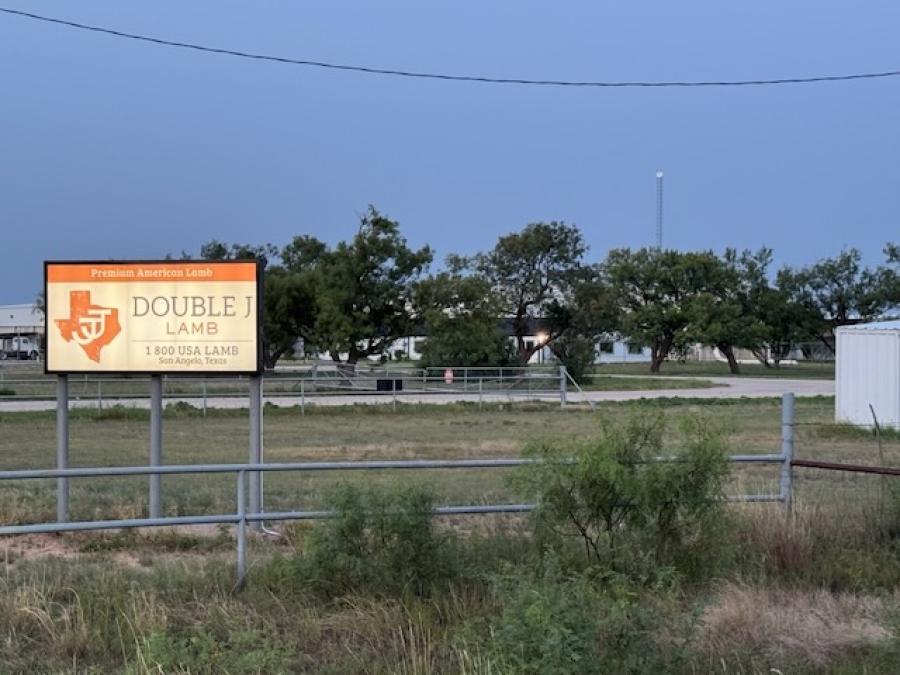
The Double J Lamb plant on City Farm Road on August 5, 2026
Subscribe to the LIVE! Daily
Required
Post a comment to this article here: